

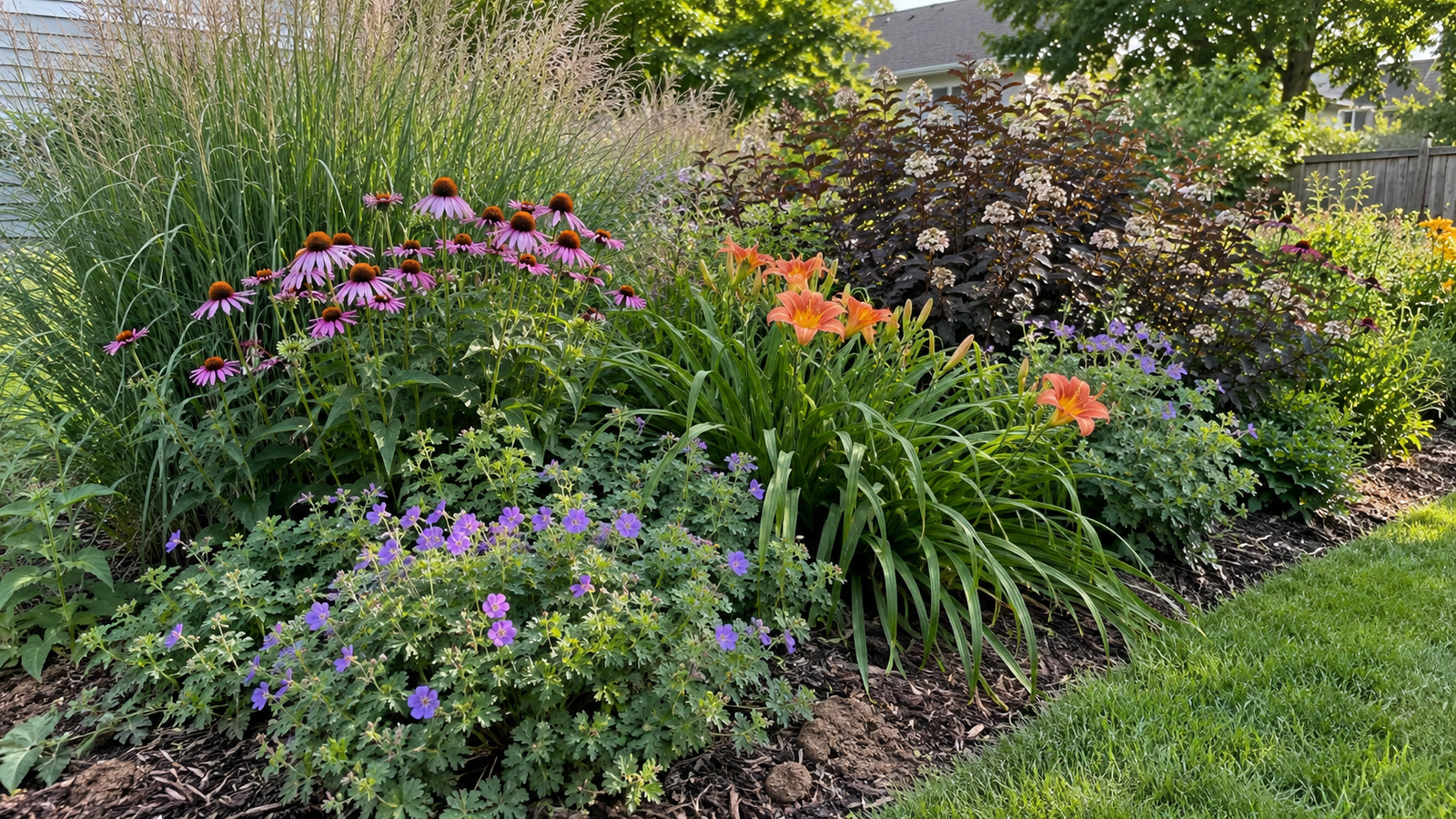
Backyard plants for clay soil need to tolerate dense ground, slow drainage, and seasonal moisture changes. Reliable choices include switchgrass, daylilies, coneflowers, ninebark, hardy geraniums, hydrangeas, hostas, astilbes, red-twig dogwood, swamp milkweed, blue false indigo, and blue flag iris.
The best plant still depends on the site. Clay that stays wet after rain needs different plants from clay that becomes hard and dry during summer. Before planting, check drainage, sunlight, seasonal moisture, mature size, climate, and the job you want the plant to perform.
What Are the Best Backyard Plants for Clay Soil?
The best backyard plants for clay soil are plants that tolerate dense soil while matching the moisture and light conditions of the planting area.
| Backyard Condition | Good Starting Choices |
|---|---|
| Sunny, normally drained clay | Switchgrass, daylily, coneflower |
| Sunny clay that dries hard | Blue false indigo, switchgrass, potentilla |
| Shaded clay | Hosta, bergenia, hardy geranium |
| Damp partial shade | Astilbe, hosta, hydrangea |
| Seasonally wet clay | Switchgrass, red-twig dogwood, sedges |
| Wet low spot | Swamp milkweed, blue flag iris, suitable Carex |
| Privacy border | Viburnum, ninebark, switchgrass |
| Pollinator bed | Bee balm, coneflower, aster, swamp milkweed |
| Low-maintenance bed | Daylily, switchgrass, hardy geranium |
Use this table as a shortlist rather than a universal planting plan. The exact species or cultivar still needs to suit your climate, available space, light level, and moisture conditions.
Why Is Clay Soil Difficult for Some Plants?
Clay soil is not poor soil by default. It often holds nutrients and moisture well. The main problem is its physical structure.
Clay particles are very small and pack closely together, leaving less space for air and water movement than well-structured loam. During wet weather, heavy clay can remain saturated long enough to reduce oxygen around plant roots. During hot or dry periods, the same soil may become hard and difficult for new roots to penetrate.
Backyard clay usually falls into one of five practical conditions:
- Normally drained clay that remains dense but does not stay waterlogged.
- Seasonally wet clay that becomes much wetter during rainy periods.
- Summer-hard clay that becomes firm during hot weather.
- Persistently wet clay where excess water remains for long periods.
- Compacted clay affected by construction, foot traffic, or repeated pressure.
The most important distinction is that clay tolerance does not automatically mean wet-soil tolerance.
A plant may grow well in dense clay but still fail if its roots remain saturated for too long.
Is the Problem Clay Soil, Compaction, or Poor Drainage?
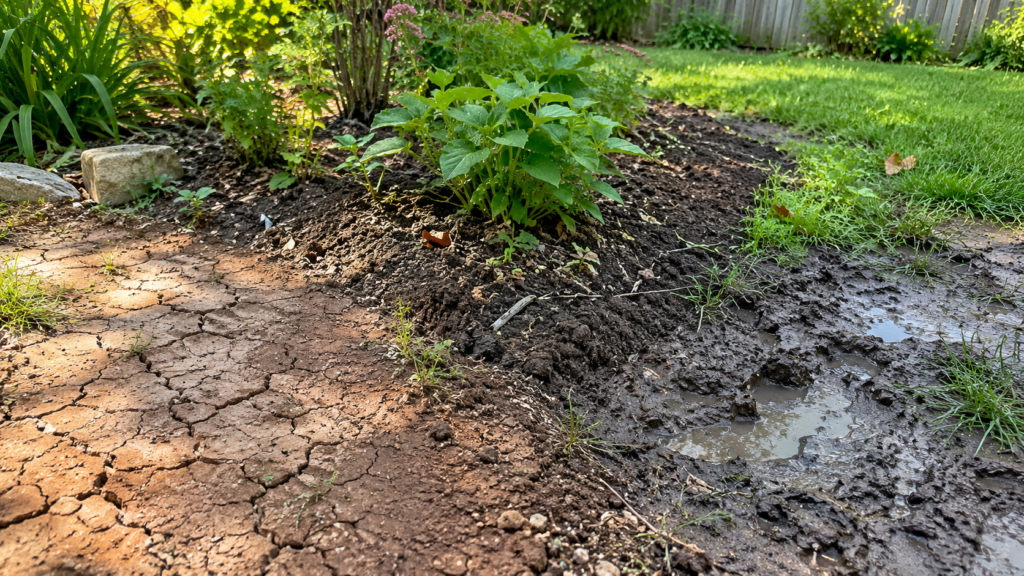
Clay, compaction, and poor drainage can create similar plant problems, but they are not the same.
Clay describes soil texture.
Compaction occurs when soil particles are pressed together and useful pore space is reduced.
Poor drainage describes slow movement of excess water away from the root zone.
Look at where the problem occurs. If most beds become sticky when wet and hard when dry, natural clay is probably the main condition. If plants fail mainly beside a patio, driveway, path, or recently constructed area, compaction may also be involved.
If only one depression stays wet, topography or drainage may be more important than the soil texture itself.
| What You Notice | Likely Issue | Best Decision |
|---|---|---|
| Most beds behave similarly | Natural clay | Choose clay-adapted plants |
| Failure beside paths or patios | Possible compaction | Check soil structure |
| One low area stays wet | Drainage or topography | Use wet-site plants or improve drainage |
| Dense soil drains reasonably | Normal clay | Use a wider clay plant palette |
| New-build soil is extremely hard | Construction compaction | Diagnose before planting |
A clay-tolerant plant can cope with naturally heavy ground, but it cannot correct severe drainage failure or badly compacted soil.
How Can You Test Clay Soil in Your Backyard?
Do not judge the entire backyard from one handful of soil.
Compare three locations: the highest or driest area, a typical planting bed, and the lowest or wettest part of the yard.
A simple infiltration comparison can reveal useful differences. Place a bottomless straight-sided container a few inches into the soil at each location, add the same amount of water, and observe how differently the sites absorb it.
Record:
- How quickly water disappears.
- Whether water remains on the surface.
- Whether the soil stays sticky the following day.
- Whether it becomes extremely hard in dry weather.
- Whether heavy foot traffic occurs nearby.
- How existing plants perform.
- Whether the location receives sun, partial shade, or shade.
If the lowest area remains much wetter, treat it as a separate planting zone. If another area becomes hard and dry in summer, choose plants with stronger dry-period tolerance.
Which 25 Backyard Plants Grow Reliably in Clay Soil?
1. Switchgrass (Panicum virgatum)
Switchgrass is one of the most versatile plants for sunny clay. It handles seasonal moisture changes better than many ornamental grasses and works well where clay shifts from moist to moderately dry.
Its upright growth makes it useful for fence lines, informal screens, and mixed borders.
Best for: screening, structure, naturalistic beds
Avoid when: the site receives deep shade
2. Daylily (Hemerocallis spp. and hybrids)
Daylilies are dependable in ordinary clay that drains reasonably well. Once established, many tolerate periods of summer dryness and work well along paths, slopes, borders, and fence lines.
They are adaptable but should not be treated as wetland plants.
Best for: borders and mass planting
Avoid when: the ground remains permanently saturated
3. Purple Coneflower (Echinacea purpurea)
Purple coneflower performs well in sunny clay that does not remain waterlogged.
It provides upright summer flowers and pollinator value and combines naturally with grasses, asters, and black-eyed Susans.
Best for: sunny borders and pollinator beds
Avoid when: the soil stays saturated for long periods
4. Black-Eyed Susan (Rudbeckia spp.)
Black-eyed Susans bring reliable summer color to sunny clay.
They work particularly well in informal, cottage-style, naturalistic, and pollinator-focused planting schemes.
Best for: summer flowers and pollinators
Avoid when: the site receives deep shade
5. Hardy Geranium (Geranium spp.)
Hardy geraniums form a useful lower layer around shrubs, grasses, and taller perennials.
They soften border edges and help cover exposed soil without overwhelming larger plants.
Best for: border edges and ground-level planting
Avoid when: soil remains continuously saturated
6. Aster (Symphyotrichum spp.)
Suitable asters extend flowering into late summer and autumn.
They work especially well with grasses and other pollinator plants, but species vary in moisture preference, so match the exact plant to the site.
Best for: late-season color and pollinators
Avoid when: the selected species does not suit the moisture level
7. Potentilla (Dasiphora fruticosa)
Potentilla is useful where a smaller shrub is needed in sunny clay.
It suits normally drained or somewhat drier clay better than persistently wet ground and works well where larger shrubs would overwhelm the space.
Best for: sunny shrub borders
Avoid when: the soil remains persistently wet
8. Bee Balm (Monarda spp.)
Bee balm works well in pollinator-focused clay gardens.
Different species vary in moisture preference, so match the exact type to the site. Good air circulation also helps in dense perennial borders.
Best for: pollinator beds and mixed borders
Avoid when: the selected species does not match site moisture
9. Swamp Milkweed (Asclepias incarnata)
Swamp milkweed is one of the strongest choices for sunny clay that stays moist or becomes seasonally wet.
It fits rain-garden-style areas, drainage depressions, and pollinator beds particularly well.
Best for: moist clay, wet beds, pollinators
Avoid when: the site becomes very dry for long periods
10. Blue Flag Iris (Iris spp.)
Suitable blue flag irises perform well in seasonally wet clay and low areas.
They work near rain gardens, drainage depressions, pond edges, and other locations that stay wetter than ordinary flower beds.
Best for: wet low spots and rain-garden planting
Avoid when: the selected iris prefers dry soil
11. Carex Sedge (Carex spp.)
Sedges provide an important lower or mid-level layer in clay landscapes.
Different Carex species prefer different combinations of light and moisture, so the exact species matters more than the general label “sedge.”
Best for: ground layers, rain gardens, naturalistic beds
Avoid when: the exact species is unknown
12. Red-Twig Dogwood (Cornus sericea)
Red-twig dogwood is especially useful in seasonally wet clay.
It provides shrub structure, informal screening, and colorful stems during the dormant season.
Best for: moist borders, screening, winter interest
Avoid when: the planting strip is too narrow
13. Panicle Hydrangea (Hydrangea paniculata)
Panicle hydrangeas provide substantial flowering structure in moisture-retentive clay where drainage remains adequate.
Cultivars vary greatly in mature size, so choose carefully near patios, paths, and foundations.
Best for: flowering shrub structure
Avoid when: the root zone remains continuously waterlogged
14. Viburnum (Viburnum spp.)
Viburnums can provide screening, flowers, foliage, and seasonal interest in clay gardens.
Because species vary greatly in size and moisture preference, select the exact species or cultivar rather than relying on the genus name alone.
Best for: screening and mixed shrub borders
Avoid when: the chosen species is oversized or regionally unsuitable
15. Ninebark (Physocarpus opulifolius)
Ninebark is a tough structural shrub for mixed clay borders.
It combines well with grasses and flowering perennials and can form a substantial mass when mature.
Best for: structure, mixed borders, screening
Avoid when: only a narrow planting space is available
16. Forsythia (Forsythia × intermedia)
Forsythia tolerates ordinary clay and provides strong early spring flowering.
It works best as an informal boundary or background shrub where its arching growth has enough room.
Best for: spring color and informal boundaries
Avoid when: the site is permanently wet or tightly confined
17. Blue False Indigo (Baptisia australis)
Blue false indigo is an excellent perennial for sunny, reasonably drained clay.
Once established, its deep root system helps it cope with dry periods, while its upright form adds structure to perennial borders.
Best for: sunny clay and pollinator planting
Avoid when: the site remains continuously waterlogged
18. Rose (Rosa spp.)
Many roses perform well in fertile clay when excess water can drain away.
Choose cultivars according to local climate, disease pressure, sunlight, mature size, and maintenance needs.
Best for: flowering borders and focal plants
Avoid when: the root zone stays saturated
19. Mahonia (Mahonia spp.)
Suitable mahonias provide evergreen or semi-evergreen structure and can work well in partially shaded clay.
Species vary in mature size and regional suitability, so check the exact plant before buying.
Best for: year-round structure and partial shade
Avoid when: the species is unsuitable in your region
20. Serviceberry (Amelanchier spp.)
Serviceberries can function as large shrubs or small ornamental trees.
They add vertical structure without requiring the space of a large canopy tree.
Best for: small-tree structure and mixed borders
Avoid when: the site remains severely waterlogged
21. Hosta (Hosta spp.)
Hostas are dependable foliage plants for shaded, moisture-retentive clay.
They work particularly well beneath larger shrubs or in layered shade borders.
Best for: shade and foliage contrast
Avoid when: standing water remains around the crown
22. Astilbe (Astilbe hybrids)
Astilbe is especially useful in damp partial shade.
Its upright flower plumes rise above lower foliage plants and combine well with hostas and bergenia.
Best for: damp shade
Avoid when: summer soil becomes extremely dry and hard
23. Sneezeweed (Helenium autumnale)
Sneezeweed suits sunny clay that stays moderately moist or becomes seasonally wet.
Its late-season flowers make it valuable in pollinator borders and rain-garden-style planting.
Best for: moist sunny clay and late-season flowers
Avoid when: the site becomes very dry
24. Bergenia (Bergenia spp.)
Bergenia produces broad foliage that creates a strong foreground layer in shaded or partly shaded clay beds.
Its bold leaves contrast well with finer grasses, sedges, and other perennials.
Best for: front-of-border foliage and partial shade
Avoid when: the species is poorly suited to the local climate
25. Japanese Anemone (Anemone hybrids and suitable species)
Japanese anemones provide valuable late-season flowers and can perform well in moisture-retentive clay with sun or partial shade.
Established plants may spread, so place them where some expansion is acceptable.
Best for: late-season flowers and partial shade
Avoid when: spreading plants would be difficult to manage
Which Clay-Soil Plant Fits Your Backyard Conditions?
The best plant is not the one with the most clay tolerance. It is the one that matches the site’s moisture, light, space, and purpose.
| Plant | Moist Clay | Summer-Dry Clay | Sun | Shade | Best Use |
|---|---|---|---|---|---|
| Switchgrass | Strong | Strong | Strong | Moderate | Screening |
| Daylily | Moderate | Strong | Strong | Moderate | Borders |
| Coneflower | Limited | Strong | Strong | Limited | Pollinators |
| Swamp milkweed | Strong | Limited | Strong | Moderate | Wet beds |
| Red-twig dogwood | Strong | Moderate | Good | Good | Screening |
| Ninebark | Moderate | Strong | Strong | Moderate | Structure |
| Blue false indigo | Limited | Strong | Strong | Moderate | Sunny perennial |
| Hosta | Good | Limited | Limited | Strong | Shade |
| Astilbe | Strong | Limited | Limited | Strong | Damp shade |
| Sneezeweed | Strong | Limited | Strong | Moderate | Moist pollinator bed |
Use the matrix to eliminate poor matches rather than to search for one universal winner.
Which Plants Grow in Clay Soil in Full Sun, Shade, or Wet Areas?
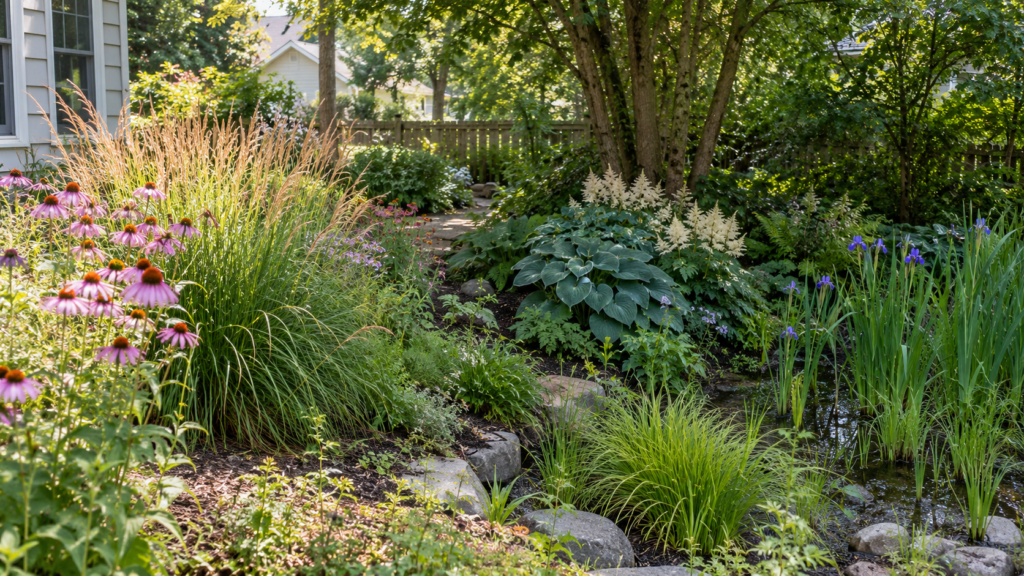
For full-sun clay, start with switchgrass, daylily, coneflower, black-eyed Susan, bee balm, blue false indigo, potentilla, ninebark, and suitable asters.
Where sunny clay becomes hard and dry during summer, blue false indigo, switchgrass, potentilla, and established daylilies are stronger starting points.
For shaded clay, consider hosta, astilbe, bergenia, hardy geranium, suitable hydrangeas, viburnums, and mahonias.
Do not assume that shade means moist soil. Large tree roots can make shaded clay surprisingly dry.
For wet clay, prioritize swamp milkweed, blue flag iris, moisture-adapted Carex, red-twig dogwood, sneezeweed, and switchgrass.
Persistent standing water should still be investigated because occasional wet-soil tolerance is different from permanent flooding.
Which Clay Plants Work Best for Different Backyard Uses?
For privacy and screening, use viburnum, ninebark, red-twig dogwood, hydrangea, or switchgrass.
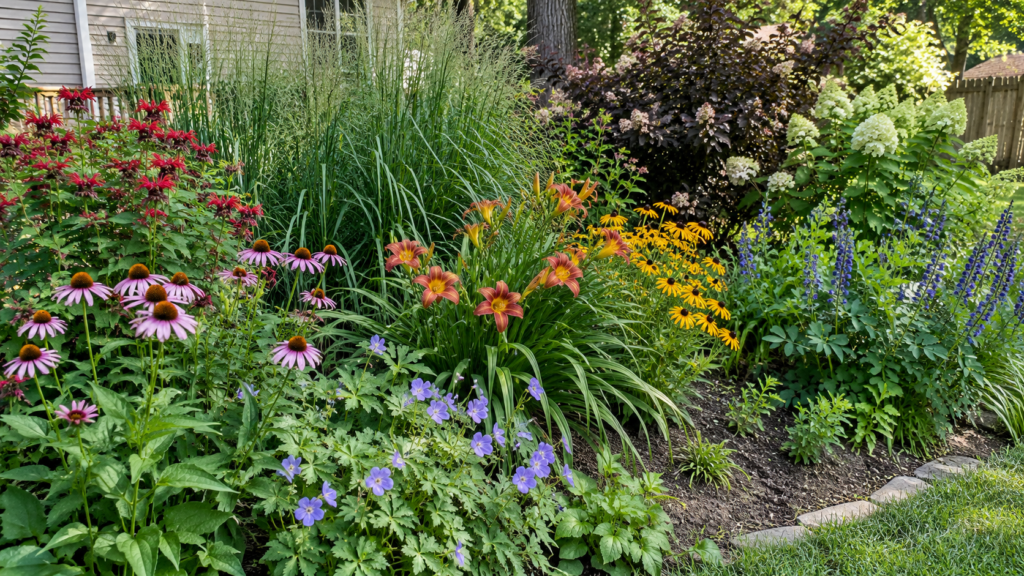
For fence planting, combine different vertical layers rather than using plants of the same height. A simple combination could use ninebark for structure, switchgrass for height, coneflower for flowers, and hardy geranium along the front.
For pollinator beds, use bee balm, coneflower, black-eyed Susan, asters, blue false indigo, sneezeweed, and swamp milkweed where regionally appropriate.
For wet low spots, choose moisture-adapted plants instead of repeatedly replacing ordinary border species.
For low-maintenance beds, repeat a small palette. Switchgrass, daylily, hardy geranium, and one suitable shrub can create a more coherent garden while simplifying maintenance.
When Should You Avoid a Clay-Tolerant Plant?
A plant can tolerate clay and still be wrong for the location.
Avoid a candidate when:
- The soil stays wetter than it tolerates.
- Summer clay becomes too dry.
- Available light is unsuitable.
- Mature width exceeds the space.
- The plant cannot provide the required function.
- The species is unsuitable for your climate.
- It is invasive or restricted locally.
- Severe compaction remains unresolved.
- Major drainage failure remains unresolved.
Use this decision sequence:
Condition → eliminate → shortlist → verify → select.
Why Do Clay-Tolerant Plants Sometimes Struggle?
When a clay-tolerant plant declines, investigate the site before replacing it.
| Symptom | Possible Cause | Best Next Step |
|---|---|---|
| Wilts while soil stays wet | Root-zone oxygen stress | Check drainage |
| Declines every summer | Poor dry-clay fit | Change plant or moisture management |
| Fails beside patio or path | Compaction or runoff | Diagnose the site |
| Healthy leaves but few flowers | Insufficient light | Reposition or replace |
| Repeated failure in a depression | Water accumulation | Use wet-clay plants |
| Constantly blocks access | Mature-size mismatch | Choose a smaller plant |
If the same species grows well elsewhere in the yard, the problem is probably the micro-site rather than clay tolerance alone.
How Should You Plant in Heavy Clay Soil?
Avoid digging or cultivating clay while it is saturated. Wet clay compacts and smears easily.
Plant when the ground is moist enough to dig but not so wet that heavy clods stick to tools.
Do not create a small hole filled with completely different loose soil inside dense clay. Roots eventually need to move into the surrounding ground.
Where improvement is needed, improve a wider area rather than only the planting hole.
Organic matter can gradually improve structure and workability. Surface mulch can reduce moisture loss, weeds, crusting, and temperature fluctuations.
Do not assume that adding a small amount of sand will transform heavy clay.
For most backyards, a more practical strategy is:
clay-adapted plants + organic matter + mulch + reduced compaction + targeted drainage improvements.
New plants still need establishment watering, but clay usually stays moist longer than sandy soil. Check below the surface before watering again.
Should You Replace Clay Soil Before Planting?
Usually, no.
Ordinary clay soil can support many shrubs, perennials, grasses, and moisture-loving plants when they are matched to the site.
More substantial intervention may be necessary if there is severe construction compaction, persistent drainage failure, contaminated soil, major grading problems, or buried construction debris.
For normal backyard clay, choosing the right plants is usually more practical than replacing the soil.
What Is a Good Layered Planting Plan for Clay Soil?
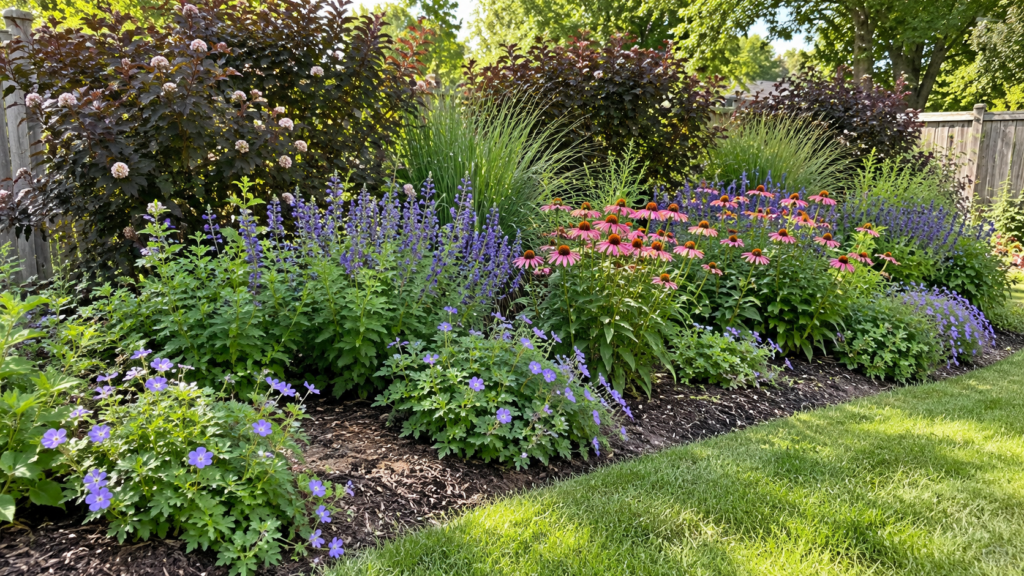
A layered planting plan helps a clay-soil border look intentional rather than like a collection of tolerant plants.
For a sunny border, try:
Ninebark → switchgrass → blue false indigo and coneflower → hardy geranium.
Ninebark provides structure, switchgrass adds height and movement, blue false indigo and coneflower create the flowering middle layer, and hardy geranium softens the front edge.
For damp partial shade, try:
Viburnum or hydrangea → astilbe → hosta and bergenia → moisture-suited sedges.
Repeating plants in groups usually creates a stronger design than planting many unrelated single specimens.
What Should You Check Before Buying Plants for Clay Soil?
Before buying a plant, check:
- Clay condition.
- Drainage.
- Sun or shade.
- Seasonal moisture changes.
- Local climate.
- Mature height.
- Mature width.
- Landscape function.
- Maintenance needs.
- Regional suitability.
Also ask:
What condition would make this plant fail here?
That question can eliminate poor choices quickly.
The strongest plant is not necessarily the one with the most attractive flowers. It is the one that matches the soil, moisture, light, climate, space, and purpose of the planting area.
What Is the Best Strategy for Planting a Clay-Soil Backyard?
Successful planting on clay starts with matching plants to the site rather than trying to make the entire yard behave the same way.
For sunny clay, begin with plants such as switchgrass, daylily, coneflower, blue false indigo, and ninebark.
For shade, consider hosta, astilbe, bergenia, hydrangea, viburnum, and hardy geranium.
For wetter clay, focus on swamp milkweed, blue flag iris, suitable sedges, sneezeweed, red-twig dogwood, and switchgrass.
Use this final decision system:
Diagnose → classify → eliminate → shortlist → verify climate and regional suitability → select by function.
Clay can support an attractive and resilient backyard. The goal is to understand how each planting zone behaves and choose plants capable of succeeding there.
FAQs About Backyard Plants for Clay Soil
What are the best backyard plants for clay soil?
Good choices include switchgrass, daylily, coneflower, hardy geranium, ninebark, hydrangea, hosta, astilbe, swamp milkweed, and blue flag iris. Match each plant to drainage, light, moisture, and climate.
What plants grow best in heavy clay soil?
Switchgrass, blue false indigo, daylily, ninebark, hardy geranium, hydrangea, viburnum, and suitable sedges are reliable options. The best choice depends on whether the clay stays wet or becomes dry and hard.
What plants grow well in clay soil and full sun?
Switchgrass, coneflower, daylily, black-eyed Susan, bee balm, blue false indigo, potentilla, and ninebark perform well in sunny clay. Choose stronger dry-clay plants where soil hardens in summer.
What plants grow well in clay soil and shade?
Hostas, astilbes, bergenia, hardy geraniums, hydrangeas, viburnums, and mahonias can suit shaded clay. Check whether the shade stays moist or becomes dry during summer.
What plants grow well in wet clay soil?
Swamp milkweed, blue flag iris, moisture-adapted Carex, red-twig dogwood, sneezeweed, and switchgrass are useful choices. Persistent standing water should still be investigated.
What plants tolerate clay that becomes hard and dry in summer?
Blue false indigo, switchgrass, potentilla, daylily, ninebark, and coneflower handle summer-dry clay better than moisture-loving plants. Establishment watering is still important.
Is clay soil the same as poorly drained soil?
No. Clay describes soil texture, while poor drainage describes slow water movement. Compaction, runoff, low spots, and restrictive soil layers can also cause drainage problems.
Should I improve clay soil before planting?
Clay often benefits from organic matter and surface mulch, but complete soil replacement is usually unnecessary. Severe compaction or drainage problems should be corrected separately.
Should I add sand to heavy clay soil?
Usually, no. Small amounts of sand are not a reliable fix for heavy clay. Organic matter, mulch, reduced compaction, and clay-adapted plants are generally more useful.
Why is a clay-tolerant plant still dying?
Waterlogging, summer drought, insufficient light, compaction, climate mismatch, or root competition may cause failure. Check the site conditions before replacing the plant.
What is the easiest way to choose plants for a clay backyard?
Use: diagnose → classify → eliminate → shortlist → verify → select by function. This is more reliable than choosing plants based on clay tolerance alone.

Myra is the founder and lead writer of Backyard Planter Ideas, where she shares practical, well-researched guidance on planter design, plant selection, and outdoor styling. Her goal is to help homeowners create attractive, functional garden spaces with clear, reliable, and easy-to-apply advice.
Blueberry Planter Ideas: Best Pots, Soil, and Growing Tips
The best blueberry planter ideas use spacious containers, acidic potting mix, and varieties suited to local weather. Wooden barrels, large patio pots, raised troughs, and compact balcony planters can all work. Aim for soil pH 4.5–5.5, steady moisture, and ample...
Hosta Planter Ideas: 21 Beautiful Designs for Shady Spaces
Hosta planter ideas can turn shaded patios, porches, balconies, and garden corners into striking foliage displays. Hostas grow successfully in containers when they have drainage holes, moisture-retentive potting mix, adequate root space, and protection from harsh afternoon sun. The best...
21 Japanese Maple Planter Ideas for Beautiful Outdoor Spaces
Japanese maple planter ideas can turn an ordinary patio, balcony, or courtyard into a garden focal point. Japanese maples (Acer palmatum) grow well in containers when their roots have drainage, consistent moisture, and protection from extreme sun and cold. The...
Geranium Planter Ideas: 15 Beautiful Designs and Growing Tips
Geranium planter ideas can brighten patios, balconies, porches, and window boxes with relatively little equipment. Choose upright zonal geraniums for bold flower clusters, trailing varieties for baskets, and companion plants with matching sunlight and moisture needs. The best results come...
Fig Tree Planter Ideas
The best fig tree planter ideas balance appearance with drainage, root space, and sunlight. Terracotta pots, wooden half-barrels, glazed ceramic containers, and lightweight resin planters all accommodate edible figs. Established trees generally benefit from around 15 gallons (57 liters) of...
Begonia Planter Ideas: 15 Beautiful Combinations for Every Space
Begonia planter ideas work best when flower color, foliage, container size, and light requirements fit together. Choose wax begonias for compact outdoor displays, trailing varieties for hanging baskets, or Rex begonias for striking indoor leaves. Combine compatible plants in well-drained...
Railing Planter Ideas: Best Designs, Plants, and DIY Tips
Railing planter ideas make balconies, decks, and porches greener without sacrificing floor space. The best choices are securely fitted saddle planters, bracket-mounted flower boxes, and hanging baskets planted with compact flowers, herbs, or strawberries. Match the container to your railing,...
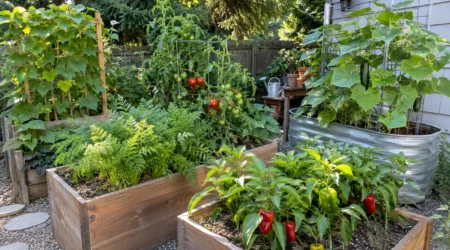
11 Best Vegetables for Deep Planters: Complete Soil Depth Guide
The best vegetables for deep planters are carrots, parsnips, daikon radishes, potatoes, sweet potatoes, tomatoes, cucumbers, peppers, eggplants, zucchini, and pole beans. Most benefit from approximately 12–24 inches of usable growing mix, although the right depth depends on variety, container...
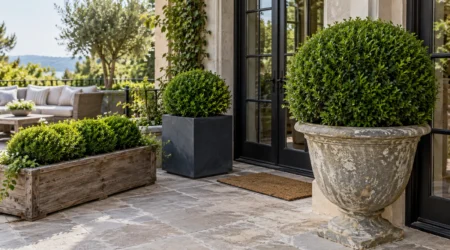
Boxwood Planter Ideas
Boxwood planter ideas bring year-round greenery to front doors, patios, courtyards, and garden pathways. These evergreen shrubs grow well in outdoor containers when they have enough root space, a free-draining growing medium, and consistent moisture. Choose compact varieties suited to...
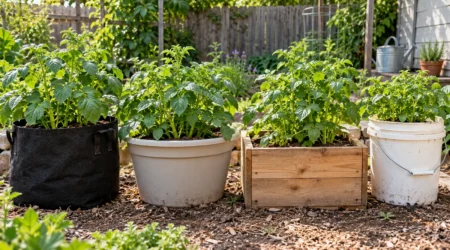
Potato Planter Ideas: 15 Easy Containers and DIY Growing Tips
Potato planter ideas range from fabric grow bags and large plastic pots to wooden boxes and homemade bucket planters. For most beginners, a wide, opaque 10–15-gallon (38–57-liter) container with drainage, loose potting mix, and six to eight hours of sunshine...